
Almost every guest asks me this question within the first five minutes of our conversation: should I do the Small Circuit or the Grand Circuit? It is a fair question, and after fifteen years guiding both routes on a near-daily basis, I can tell you the honest answer depends entirely on how much time you have and what you actually want from your visit to Angkor. Let me walk you through both, temple by temple, so you can decide for yourself.
What “Circuit” Actually Means
The Angkor Archaeological Park is enormous — roughly 400 square kilometers containing hundreds of temple structures. To make this manageable, the routes through the park were organized decades ago into two main loops that most visitors and guides still use today: the Small Circuit (sometimes called the Inner Circuit) and the Grand Circuit (the Outer Circuit). Angkor Wat itself sits slightly apart from both loops, usually visited first thing in the morning regardless of which circuit you choose afterward.
The Small Circuit — What You’ll See
The Small Circuit covers roughly 17 kilometers and typically takes a full day, though it can be shortened to a half day if you move quickly. This is the route almost every first-time visitor takes, and for good reason — it contains the most famous and most photographed temples in the entire park.
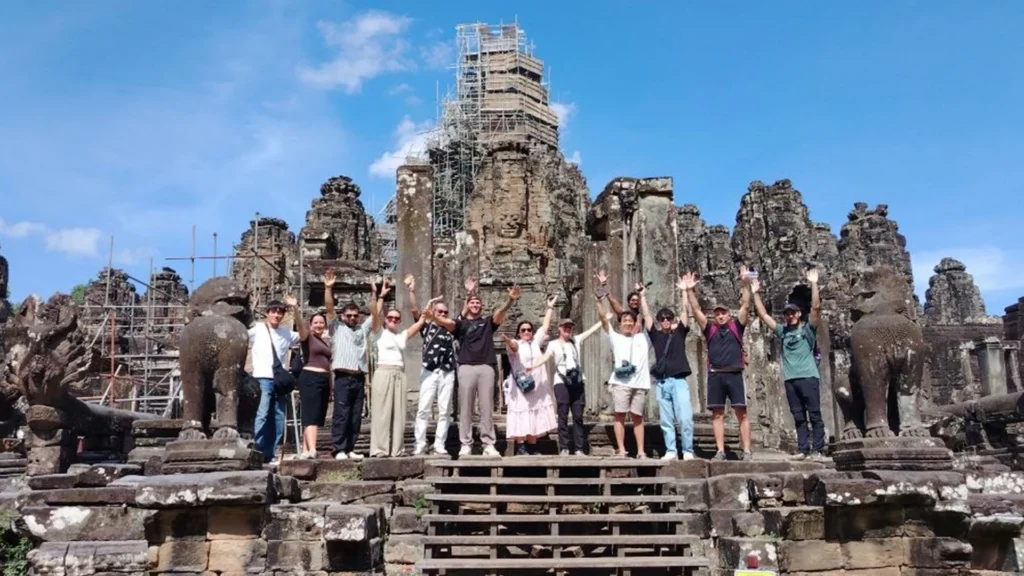
Angkor Thom and the Bayon. After Angkor Wat, most Small Circuit routes enter the walled city of Angkor Thom through the South Gate, famous for the row of stone figures — gods on one side, demons on the other — lining the bridge over the moat. Inside sits the Bayon, instantly recognizable for its 216 giant carved stone faces, believed to represent either the bodhisattva Avalokiteshvara or a divine image of King Jayavarman VII himself, historians still debate which.
Baphuon and the Terrace of the Elephants. These sit just north of the Bayon. Baphuon is a massive pyramid-temple that took nearly two decades to restore after French archaeologists literally had to reassemble it stone by stone following extensive damage. The Terrace of the Elephants was the public audience hall of the Khmer kings, its retaining wall carved with life-sized elephant reliefs that give the terrace its name.
Ta Prohm. Almost everyone recognizes this temple even before visiting — it is the one where enormous silk-cotton and strangler fig tree roots have grown directly into and around the stone structures, made globally famous after appearing in the 2001 film Tomb Raider. I always tell guests that photographs genuinely do not capture how large these roots are in person.
Banteay Kdei and Srah Srang. Often the final stop on a Small Circuit day, Banteay Kdei is a quieter Buddhist temple with beautiful carved doorways, sitting opposite Srah Srang, a massive man-made reservoir originally built for royal bathing and ceremonies.
The Grand Circuit — What You’ll See
The Grand Circuit covers a much larger loop, roughly 26 kilometers, extending further east and north of the Small Circuit temples. It generally requires a full day on its own and is best suited to travelers with two or more days in Siem Reap, or those who have already done the Small Circuit on a previous visit.
Preah Khan. One of the largest temple complexes in Angkor, originally serving as a Buddhist university and religious center. Preah Khan has a labyrinth-like quality with long processional corridors, and unlike Ta Prohm, its jungle overgrowth is still actively managed rather than fully restored, giving it a genuinely wild, half-discovered feeling.
Neak Pean. A small, unusual island temple built in the middle of an artificial pond, originally designed as a place of ritual healing where visitors would bathe in the surrounding pools believed to balance the four elements. It is a peaceful, quieter stop and a nice contrast after the scale of Preah Khan.
Ta Som. A modest single-shrine temple, notable for a large fig tree that has grown directly over its eastern gate, similar in spirit to Ta Prohm but on a much smaller scale and with far fewer visitors.
East Mebon and Pre Rup. Both are pyramid-style state temples built on similar architectural plans roughly a decade apart, decorated with well-preserved carved lions and elephant sculptures at their corners. Pre Rup in particular is a favorite of mine for late afternoon light, when the reddish sandstone glows warmly in the setting sun.
The Honest Comparison
If you only have one day in Siem Reap, the Small Circuit is the correct choice. It contains Angkor’s most architecturally significant and visually striking sites, and skipping it in favor of the Grand Circuit would mean missing the temples most people specifically travel here to see.
If you have two or three days, I almost always recommend the Small Circuit on day one and the Grand Circuit on day two. The Grand Circuit temples are generally less crowded, spread further apart, and reward visitors who already have a foundation of Khmer history and architecture from the previous day’s visit. Guests frequently tell me the Grand Circuit felt more personal and less rushed precisely because there were fewer other tour groups moving through at the same time.
Physically, the Grand Circuit involves more time in the vehicle between temples since the sites are spread across a wider area, while the Small Circuit involves more walking within a tighter cluster of temples.
A Note on Combining Both in One Day
I am occasionally asked whether both circuits can be combined into a single day. Technically it is possible, but I do not recommend it. You would spend the majority of the day traveling between sites rather than actually experiencing them, and the heat of the afternoon combined with rushed pacing tends to leave guests exhausted rather than genuinely satisfied. If time is truly limited, a well-chosen selection of highlights from both circuits, tailored to your specific interests, works far better than attempting to see everything.
Frequently Asked Questions
Which circuit has Angkor Wat itself? Neither, technically. Angkor Wat sits on its own axis and is almost always visited separately, typically first thing in the morning for sunrise, before either circuit begins.
How many days do I need to see both circuits properly? Two full days is the minimum for a relaxed, non-rushed experience — one day per circuit. Three days allows time to revisit favorite sites or add the Tonle Sap floating villages.
Is the Grand Circuit worth it if I only have one day total? For a first visit, no. The Small Circuit contains the temples most associated with Angkor’s global reputation. Save the Grand Circuit for a return trip or a second day.
Are the Grand Circuit temples less impressive than the Small Circuit temples? Not at all — they are simply less famous. Preah Khan in particular rivals Ta Prohm in scale and atmosphere, and many guests who visit both circuits tell me the Grand Circuit was their personal favorite, precisely because it felt less like a tourist attraction and more like genuine discovery.
Deciding between the two circuits is exactly the kind of question I help every guest work through before we even set a date. Tell me how many days you have in Siem Reap and what you are hoping to experience, and I will help you build the right itinerary — whether that’s one focused day or a complete multi-day exploration of Angkor, guided personally in English or Japanese.